
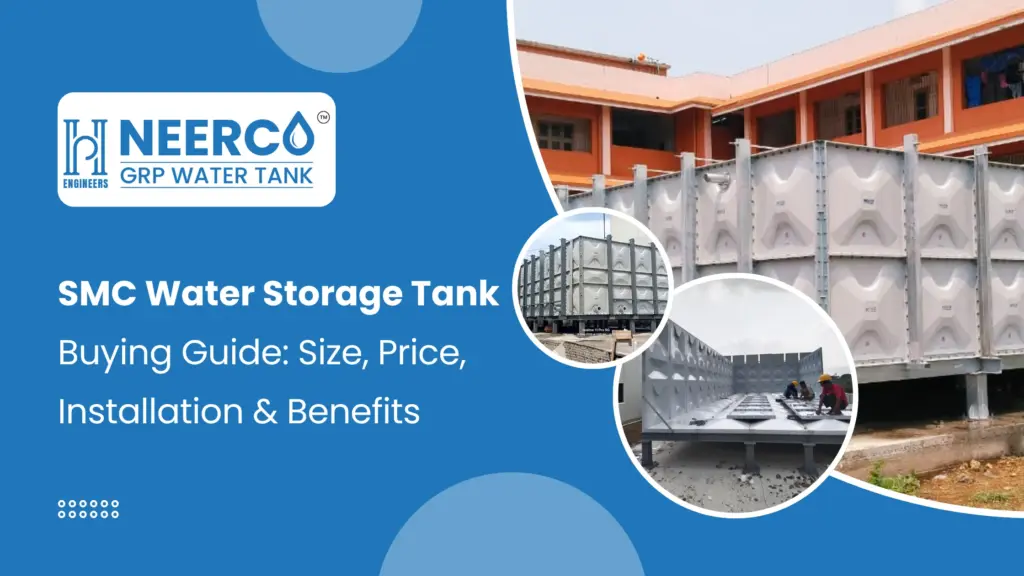
If you’re planning an SMC water storage tank rooftop installation, you’re making one of the smartest infrastructure decisions for your facility. SMC (Sheet Moulding Compound) panel tanks are the preferred choice for industrial plants, commercial buildings, hospitals, and residential complexes across India and globally, and for good reason. This guide covers everything. Securing teams, engineers, and facility managers needs sizes, pricing, installation requirements, and key benefits.
What Is an SMC Water Storage Tank?
An SMC panel tank (also called a GRP modular panel tank) is a water storage solution made from glass-fiber-reinforced thermosetting resin panels. The panels are bolted together on-site, making them highly customizable for rooftop, underground, and ground-level installations. Quick Definition: SMC tanks are modular, corrosion-resistant water storage tank manufactured under international standards, including BS EN 13280 and ISO 9001.
Why Choose SMC Water Storage Tank Rooftop Installation?
Rooftop placement maximizes gravity-fed water distribution, reducing pump dependency and operational costs. Here’s why facility managers prefer SMC for elevated installations:
- Lightweight panels — Easy to transport and hoist to rooftops without heavy craning
- Modular assembly—Built in-place without welding or large equipment
- Corrosion-free — No rust, no bacterial growth, no taste or odour contamination
- UV-resistant coating — Withstands direct sunlight on exposed rooftop sites
- Seismic-rated options — Available with reinforced frames for earthquake-prone zones
Unlike traditional RCC or metal tanks, SMC panels are food-grade certified and require no internal lining, a major cost and maintenance advantage.
SMC Panel Tank Sizes: What to Choose?
| Capacity | Dimensions (Approx.) | Best For |
| 1,000 – 5,000 L | 1m × 1m base | Residential rooftops |
| 5,000 – 20,000 L | 2m × 2m to 3m × 2m | Commercial buildings |
| 20,000 – 100,000 L | 4m × 4m and above | Industrial/hospital complexes |
| 100,000 L+ | Custom modular | Large plants, municipalities |
Panel thickness commonly ranges from 8mm to 15mm, with thicker panels used for larger tanks and higher pressure loads. Always consult your structural engineer before finalizing rooftop tank features.
SMC Panel Tank Price in India
Prices vary based on insulation needs, inlet/outlet fittings, access manholes, and certified installation service. Always request itemized quotations inclusive of supply, delivery, and erection charges. SMC panel tank pricing depends on capacity, panel grade, frame material, and supplier. General indicative ranges:
- Small tanks (1,000–5,000 L): ₹15,000 – ₹40,000
- Medium tanks (10,000–50,000 L): ₹60,000 – ₹2,50,000
- Large tanks (1,00,000 L+): ₹3,00,000 and above (custom quotation)
SMC Water Storage Tank Rooftop Installation: Step-by-Step
Proper SMC water storage tank rooftop installation requires structural planning, skilled assembly, and post-installation testing.
Step 1 – Structural Assessment:
Verify rooftop load-bearing capacity with a civil/structural engineer. A full 10,000-litre tank exerts roughly 10 tonnes of load; know your slab rating.
Step 2 – Base Frame & Anti-Vibration Pads:
Install a galvanised or stainless steel support frame with anti-vibration isolators. Ensure a perfectly level surface; misalignment causes panel stress over time.
Step 3 – Panel Assembly:
Bolt SMC panels together using EPDM rubber seals and stainless steel hardware. Follow manufacturer torque specifications to ensure leak-proof joints.
Step 4—Inlet, Outlet & Overflow Connections:
Connect water supply (ball valve), distribution outlet, overflow pipe, and drain valve. All fittings must use food-grade materials.
Step 5 – Pressure & Leak Testing:
Fill the tank and hold water for 24 hours. Inspect all joints, seals, and fittings for leaks before putting the system into service.
Step 6 – Access & Safety:
Install a lockable manhole cover, an internal ladder (if required), and an insulating cover if the tank is exposed to extreme temperatures.
Key Benefits of SMC Panel Tanks for Industrial Buyers
| Benefit | Impact |
| 25–30 year lifespan | Lower lifecycle cost vs. steel tanks |
| Hygienic food-grade material | WHO & BIS-compliant water storage |
| Modular design | Expand capacity without full replacement |
| Low maintenance | No painting, lining, or re-coating needed |
| Fast installation | On-site assembly in 1–3 days |
Technical Considerations Before Buying
- Panel grade: Choose higher resin content (≥30% glass fibre) for better structural integrity in large tanks
- Frame material: Hot-dip galvanised steel or SS304 for rooftop environments
- Insulation: Foam-injected double-layer panels for hot climates or cold storage applications
- Certifications: Ensure compliance with BS EN 13280, NSF/ANSI 61, or IS 12701 standards
- Warranty: Industry-standard warranties range from 10 to 25 years on panels
Maintenance Tips to Maximise SMC Water Tank Life
- Annual inspection — Check all panel joints, bolts, and seals
- 6-monthly cleaning—Drain, rinse, and disinfect interior with chlorine solution
- Check inlet filters — Prevent sediment accumulation.
- Inspect support frame — Look for corrosion, especially post-monsoon
- Test water quality — Quarterly microbiological testing recommended
Ready to Install the Right SMC Panel Tank for Your Project?
Whether you’re outfitting a commercial rooftop, industrial plant, or residential complex, getting the tank specification right from day one saves time, cost, and compliance headaches. HP Engineers provide high-quality SMC tanks along with professional guidance to ensure smooth installation and long-lasting water storage solutions.
Click Here →Why SMC Is Replacing Traditional Tanks
As per the Bureau of Indian Standards (BIS) and global water infrastructure reports, modular GRP/SMC tanks are replacing concrete and galvanised steel tanks across municipal, industrial, and commercial projects due to the following:
- Faster project timelines
- Lower total cost of ownership
- Compliance with modern water hygiene standards
- Ease of capacity scaling without civil works
Conclusion
Choosing the right SMC water storage tank rooftop installation is not just a procurement decision; it’s a long-term infrastructure investment that directly impacts water quality, operational efficiency, and maintenance costs for years to come. From their modular, corrosion-free construction to 25–30-year lifespan and compliance with international standards like BS EN 13280 and IS 12701, SMC panel tanks regularly outperform traditional RCC and metal tank options in both operation and total cost of ownership. Whether you manage a residential building, a commercial complex, or a large industrial facility, the key is to plan carefully, assess your rooftop load capacity, choose the right tank size and panel grade, and always insist on certified materials and professional installation.
FAQs
1. What is the lifespan of an SMC water storage tank installed on a rooftop?
SMC panel tanks typically last 25 to 30 years with proper maintenance. Their corrosion-resistant and UV-stable construction makes them ideal for rooftop exposure.
2. How much does SMC water storage tank rooftop installation cost in India? Installation costs depend on tank size, access difficulty, and local labor rates. For a 10,000-litre tank, the total supply-and-installation cost typically ranges from ₹80,000 to ₹1,80,000.
3. What structural requirements are needed before rooftop tank installation?
Your rooftop slab must support the full water-loaded weight of the tank. A structural engineer should verify load capacity. A galvanised steel frame and anti-vibration pads are mandatory for safe installation.
4. Can SMC panel tanks be expanded after installation?
Yes. SMC tanks are modular; additional panels can be added to increase capacity without replacing the entire structure, a major advantage over fixed-form tanks.
5. Are SMC tanks safe for drinking water storage?
Absolutely. Food-grade SMC materials are free from harmful chemicals. Look for tanks certified under NSF/ANSI 61, IS 12701, or BS EN 13280 to ensure drinking water safety compliance.