
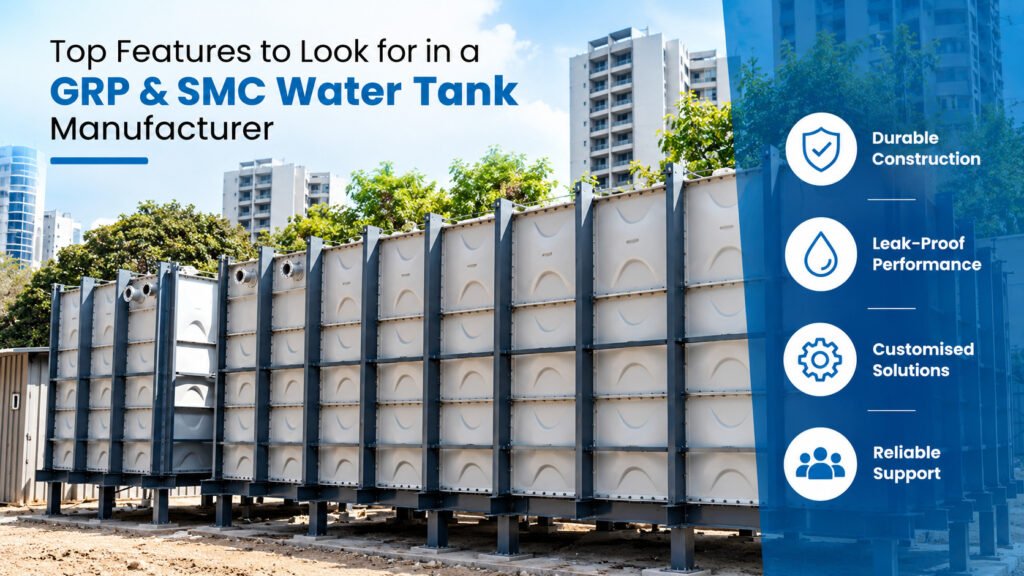
When choosing a GRP or SMC water tank manufacturer, look for proven project experience, food-grade materials, panels tested to IS 14399, potability test reports, the right panel thickness for your tank’s depth, customisation, professional installation and leak testing, and clear warranty and after-sales support. Ask for test certificates, client references and site photos before you place an order.
A water tank is one of those things you only think about when it goes wrong. A leaking joint on a rooftop, algae in drinking water or a panel bulging under pressure can disrupt a whole building, damage property and put people’s health at risk.
That’s why choosing the right GRP water tank manufacturer matters as much as choosing the tank itself. Two tanks can look identical on a quotation, but the raw materials, panel thickness, testing and installation quality behind them can be very different.
This guide explains what GRP and SMC water tanks are, the features that separate a reliable manufacturer from a risky one, and a practical checklist for how to choose a GRP water tank manufacturer.
It’s written by the team at H P Engineers, which manufactures SMC and GRP panel water tanks under the NEERCO brand from its factory at GIDC Chhatral, Gandhinagar, Gujarat. We’ve supplied tanks for residential, commercial, hospital, hotel and industrial projects across India, so this checklist reflects the questions we see buyers ask, and the ones we wish more of them would.
Understanding GRP and SMC Water Tanks
What Are GRP and SMC Water Tanks?
GRP (glass reinforced plastic) is a composite material made of polyester resin reinforced with glass fibre. It’s strong, light and doesn’t rust, which makes it ideal for water storage.
SMC (sheet moulding compound) is a ready-to-mould sheet of resin, glass fibre and fillers. SMC panels are made by pressing this compound in heated steel moulds under high pressure. The result is a type of GRP panel with consistent thickness, strength and a smooth, non-porous surface.
So every SMC panel tank is a GRP panel tank, but not every GRP panel tank is made from SMC. Some GRP tanks use hand lay-up or other methods, which can vary more in quality. In India, hot-press moulded GRP sectional tanks are covered by IS 14399, which sets requirements for panels (Part 1) and for assembly, installation and testing (Part 2). You can read a detailed breakdown in our guide to IS 14399 requirements for SMC panel tanks.
How Panel Tanks Are Built
Panel tanks are modular. Individual panels, usually 1 m × 1 m, 1 m × 0.5 m or 0.5 m × 0.5 m under IS 14399, are bolted together on site with non-toxic sealants, internal or external stays, and a steel support structure. This means a large tank can be carried up stairs, through narrow access or onto a rooftop in pieces, and assembled where it’s needed.
Benefits of GRP and SMC Water Tanks
- Corrosion-free: No rust, unlike steel tanks.
- Hygienic: A smooth, non-porous inner surface resists algae and bacteria, and opaque panels block sunlight.
- Lightweight but strong: Easier to transport and install than concrete or steel, with high strength-to-weight ratio.
- Modular and scalable: Capacity can range from about 1,000 litres to several lakh litres.
- Leak-resistant: Properly sealed joints and leak testing prevent seepage.
- Long service life: Well-made SMC tanks typically last 25–30 years with basic maintenance.
- Low maintenance: Easy to inspect, clean and repair panel by panel.
How GRP and SMC Tanks Compare With Other Tank Types
| Feature | SMC / GRP panel tank | RCC (concrete) tank | Steel tank | Plastic (rotomoulded) tank |
|---|---|---|---|---|
| Corrosion | Doesn’t rust | Can crack and seep | Rusts without coating | Doesn’t rust |
| Capacity | Small to very large | Large | Medium to large | Small, usually under 10,000 L |
| Installation | Modular, bolted on site | Built on site, slow | Welded or bolted | Single piece, limited by access |
| Weight | Light | Very heavy | Heavy | Light |
| Hygiene | Smooth, non-porous | Porous surface | Depends on coating | Smooth |
| Repair | Replace single panels | Difficult | Welding or coating | Usually replace tank |
For large or hard-to-reach installations, panel tanks combine the hygiene of plastic with the capacity of concrete, without the weight.
Applications and Common Uses
| Sector | Typical use |
|---|---|
| Residential buildings | Overhead and underground drinking water storage |
| Hospitals and hotels | Large, hygienic potable water storage |
| Malls and offices | Domestic and flushing water storage |
| Industrial plants | Process water, cooling water and RO water |
| Fire protection | Dedicated fire water reserve tanks |
| Agriculture | Irrigation and rainwater harvesting |
| Infrastructure and utilities | Townships, railways, airports and water treatment plants |
See more on our applications page.
Key Features to Look for in a Manufacturer
Not all GRP and SMC water tank manufacturers offer the same quality. Here are the six features that matter most.
1. Experience and Expertise in the Industry
Experience shows up in details: correct panel selection, strong support structures, accurate leak testing and smooth installation on difficult sites.
Look for:
- Completed projects similar to yours in size and type
- Named clients in residential, commercial or industrial sectors
- In-house design and engineering for capacity, layout and supports
- Own manufacturing facility rather than reselling another company’s panels
- Trained installation teams, not casual labour
H P Engineers has supplied tanks for clients including Reliance, Adani, Oberoi Realty, Lodha, Tata Power Solar, The Leela and Schneider Electric. You can see the full list on our clients page.
2. Quality of Materials Used
The panel is only as good as what goes into it. A reliable SMC water tank manufacturer should use:
- Food-grade unsaturated polyester resin, so nothing harmful leaches into stored water
- E-glass fibre with a glass content of at least 30% by weight in the compound, as specified in IS 14399
- UV-stabilised outer surfaces for rooftop tanks exposed to sunlight
- Non-toxic sealants and hot-dip galvanised or stainless steel bolts and stays
- Correct panel thickness for depth, because deeper tanks need thicker bottom and lower side panels to handle water pressure
| Property (IS 14399 minimum) | Requirement |
|---|---|
| Tensile strength | 70 MPa |
| Bending strength | 100 MPa |
| Elastic modulus | 6,000 MPa |
| Barcol hardness | 50 |
| Water absorption | 0.5% maximum |
Ask the manufacturer for test results against each property. Our SMC panel tank page shows NEERCO panel values compared with the IS 14399 requirements.
3. Compliance With Standards and Certifications
Certifications are the easiest way to separate claims from proof. Ask for:
- IS 14399 compliance, ideally with a BIS licence and licence number you can verify
- Potability test reports confirming the tank is safe for drinking water, covering taste, odour, toxic metals and microbial limits
- ISO quality management certification for the factory
- Third-party approvals relevant to your project, such as CPWD approval for government work or NSF certification
- Test reports from recognised labs, not just a brochure statement
If a manufacturer can’t show documents, treat the claim as unverified.
4. Customisation Options Available
Every site is different. A good GRP panel tank manufacturer should be able to customise:
- Capacity and dimensions to fit available space and height
- Partitioned tanks, for example separating drinking water from fire reserve
- Overhead, rooftop or underground configurations
- Internal or external bracing depending on access and space
- Fittings and accessories: inlets, outlets, overflows, drains, manholes, vents, ladders, level indicators and walkways
- Insulated panels where temperature control matters
Ask for a drawing showing the panel layout, support structure and accessories before you approve the order.
5. After-Sales Support and Service
A tank should serve you for decades, so the relationship shouldn’t end at delivery. Check whether the manufacturer offers:
- Professional installation by its own trained team
- A leak test after assembly, with the tank filled and observed, as IS 14399 Part 2 requires
- Handover documents, including drawings, test reports and maintenance guidance
- Spare panels, gaskets and fittings for future repairs
- Relocation, expansion or modification support
- Quick response to service calls
Learn more about our installation and service support.
6. Warranty and Maintenance Offerings
A clear warranty shows that a manufacturer stands behind its product. Before ordering, confirm:
- Warranty period for panels and for workmanship, separately
- What’s covered, such as leakage, panel cracking or UV damage, and what isn’t
- Conditions, such as maintenance requirements or approved installation
- Annual maintenance contracts (AMC) for cleaning, inspection and sealant checks
Get the warranty in writing as part of your purchase order.
Why Choose a Reliable Manufacturer?
The Importance of Trust and Reliability
A water tank stores something everyone in the building depends on. A reliable GRP water tank manufacturer gives you:
- Safe water, because materials and potability have been tested
- Predictable performance, because panels are designed for your tank’s depth and loads
- Fewer surprises, because delivery, installation and testing are planned properly
- Long-term value, because a tank that lasts 25–30 years costs less than one replaced after five
Consequences of Poor-Quality Tanks
Cheaper tanks can cost far more over their lifetime. Common problems include:
- Leaks at joints from poor sealants or untrained installation
- Panel bulging or cracking because thin panels were used at depth
- Algae growth inside translucent or porous panels
- Contaminated water from non-food-grade resins or fillers
- Corroded supports and bolts made from untreated steel
- Structural failure on rooftops without proper support design, which is especially risky in earthquake-prone areas
Rooftop tanks need particular care. Our article on earthquake-safe rooftop water storage explains how tank design and supports affect safety.
How to Choose a GRP Water Tank Manufacturer
Use this step-by-step approach to compare GRP water tank suppliers and manufacturers with confidence.
1. Research and Compare Manufacturers
Shortlist three to five GRP water tank manufacturers in India and compare them on the same points:
| What to compare | Questions to ask |
|---|---|
| Manufacturing | Do they make their own panels? Can you visit the factory? |
| Standards | Can they show IS 14399 compliance and potability reports? |
| Materials | What resin, glass content and panel thickness do they use? |
| Design | Will they provide drawings and support structure design? |
| Installation | Is installation done by their own trained team? |
| Testing | Do they leak-test the tank after assembly? |
| Warranty | How long, and what exactly does it cover? |
| Price | Does the quote include supports, accessories, installation and GST? |
Compare like for like. A lower quote may simply leave out supports, accessories or installation.
2. Read Customer Reviews and Testimonials
Check Google reviews, testimonials and case studies. Look for comments about leak-free performance, on-time delivery, installation quality and service response, rather than just general praise.
3. Ask for Referrals and Recommendations
Ask the manufacturer for references from projects similar to yours, and call them. Builders, architects, MEP consultants and plumbing contractors also know which SMC panel tank manufacturers in India deliver reliably. If possible, visit a completed installation.
4. Evaluate Their Customer Service
How a manufacturer handles your enquiry is a good preview of how it will handle a problem later. Notice whether they:
- Respond quickly and clearly
- Ask about your site, usage and capacity before quoting
- Explain technical details in plain language
- Provide documents without hesitation
- Give realistic delivery and installation timelines
5. Get the Size Right
Before finalising, confirm the capacity you actually need. It depends on the number of users, daily demand per person, how reliable your water supply is and whether you need a separate fire reserve. Our water tank capacity calculation guide explains the method using National Building Code figures.
Conclusion
Choosing the right GRP water tank manufacturer protects your water quality, your building and your budget for decades. Look for proven experience, food-grade materials, IS 14399 compliance with test reports, the right panel thickness for your tank’s depth, flexible customisation, professional installation and leak testing, and a clear warranty with dependable after-sales support.
Take time to compare manufacturers on the same criteria, ask for documents and references, and visit a completed project if you can. The extra effort upfront saves years of leaks, repairs and water quality problems.
Looking for a trusted GRP and SMC water tank manufacturer? Explore H P Engineers’ SMC panel tanks and GRP panel tanks, or contact our team for expert advice, drawings and a detailed quotation. Call +91 9624941567 or email info@hpengineers.co.in.
Frequently Asked Questions
GRP water tanks don’t rust, are lightweight but strong, resist algae and bacteria, and can be built in modular sizes from about 1,000 litres to several lakh litres. They’re easy to install in tight spaces, need little maintenance and typically last 25–30 years.
Clean the tank regularly, typically every six months, and more often for drinking water in dusty areas. Inspect joints, sealants, bolts and supports for leaks or corrosion, keep the manhole and vents closed and screened, and check the overflow and drain. An annual maintenance contract makes this easier.
A well-made SMC panel tank typically lasts 25–30 years when it’s installed correctly and maintained regularly. Lifespan depends on material quality, UV protection, support structure and maintenance.
Yes, when they’re made from food-grade resin and tested for potability. Ask the manufacturer for potability test reports and IS 14399 compliance before buying a tank for drinking water.
Multiply the number of users by daily water demand per person, then multiply by the number of days of storage you need based on supply reliability. Add a margin for growth and any separate fire reserve. A manufacturer can help confirm the final size and layout.
GRP is the general material: glass fibre-reinforced plastic. SMC is a specific type of GRP made by hot-press moulding sheet moulding compound, which gives more consistent thickness, strength and surface quality.
Yes. Because panel tanks are modular, they can usually be dismantled, relocated or expanded by adding panels, as long as the support structure is designed for the new size.
Yes. GRP and SMC panel tanks are widely used for fire water reserves, either as separate tanks or as partitioned sections of a larger tank. Size them to your local fire authority’s requirements.