
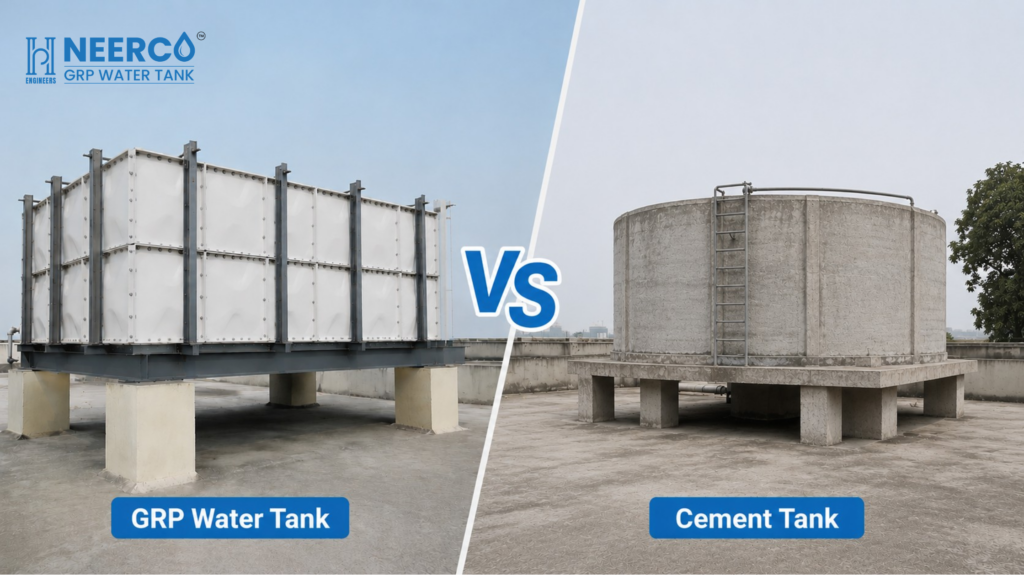
If you are planning a water storage system for your home, building, or facility, one question comes up repeatedly: GRP water tank or cement tank? Cement tanks were the default choice for decades. But in recent years, GRP water storage tanks have replaced concrete tanks across residential, commercial, and industrial projects in India. The reason is not just one factor. It is a combination of practical advantages that make GRP a smarter, more cost-effective choice over time.
This blog breaks down the key GRP water tank advantages over cement tanks so you can make a well-informed decision for your project.
What Is a GRP Water Tank?
A GRP water storage tank is made from Glass Reinforced Plastic, a composite material combining glass fiber and high-grade resin. It is built from pre-fabricated modular panels that are bolted together on-site, as covered in detail in our GRP Panel Tank Complete Guide.
Unlike a concrete tank that is constructed in place using materials like brick, cement, and plaster, a GRP tank is factory-manufactured, quality-tested, and assembled quickly at the installation site.
This difference in construction is at the root of most GRP tank benefits over cement tanks.
1. Lightweight Structure, Easier Installation, Lower Civil Cost
One of the most practical GRP water tank advantages is how light the material is.
GRP panels are significantly lighter than concrete. A cement tank of equal capacity requires thick walls, heavy reinforcement, and a strong supporting structure beneath it. A GRP water storage tank, on the other hand, puts far less load on the structure it sits on.
This matters most for rooftop installations. A concrete tank on a terrace requires a specially designed slab to handle the extra weight. A GRP tank can usually be installed on an existing roof with standard load-bearing calculations.
Less dead load means lower civil construction cost and faster installation, especially for multi-storey buildings, hospitals, and commercial projects.
2. Faster Installation Without Curing Time
Building a cement tank is a time-consuming process. The construction involves brickwork, plastering, waterproofing layers, and a mandatory curing period. Depending on size and weather conditions, this can take several weeks.
A GRP panel tank is assembled on-site from ready panels using bolts and sealants. A standard 10,000-litre to 50,000-litre tank is typically installed in one to two days.
There is no curing period, no waiting for concrete to set, and no delay before the tank can be filled and used.
For projects with tight timelines, factories, hospitals, housing complexes under completion, this speed of installation is a significant GRP tank benefit.
3. No Seepage, No Cracks, No Leakage Over Time
Concrete tanks develop cracks. It is a well-documented problem.
Cement is a porous material. Over time, temperature cycles, ground movement, and water pressure cause hairline cracks to form. These cracks allow water to seep out, wasting thousands of litres annually. Worse, cracks also allow outside contaminants, insects, and roots to enter the tank.
Repair work on a leaking concrete tank is messy, disruptive, and often temporary. The problem tends to return.
GRP panels are non-porous. They do not absorb water, they do not crack under normal operating conditions, and the bolted joint system with rubber gaskets provides a watertight seal. This is one of the most important reasons why contractors and facility managers choose GRP water storage tanks, they stay leak-free for decades without repair.
4. Hygienic Water Storage: No Algae, No Rust, No Contamination
Water quality is directly linked to the tank material it is stored in.
Concrete tanks have rough, porous inner surfaces that allow algae to grow and bacteria to settle. Plastering used inside cement tanks can degrade over time, introducing fine particles into the stored water. Without regular cleaning and recoating, water quality inside a concrete tank deteriorates.
GRP has a smooth, non-toxic inner surface that does not support algae or bacterial growth. The material is food-grade safe and does not leach any harmful chemicals into the water. It does not rust, unlike steel tanks, and does not corrode like older concrete lining systems.
This is why GRP water storage tanks are preferred in hospitals, food processing plants, schools, and housing projects where water quality is non-negotiable.
Are you looking for a durable, hygienic, and cost-effective water storage solution for your project?
Connect with HP Engineers today to explore high-quality GRP water tanks tailored to your specific requirements.
Click here5. Flexible Sizing: Built to Fit Your Exact Requirement
A concrete tank must be designed and constructed from scratch for every project. Changing the size or shape after construction begins is extremely difficult and costly.
GRP tanks are built from standard modular panels. Capacity, length, width, and height can all be adjusted in 0.5-metre and 1-metre increments. Whether you need a 2,000-litre rooftop tank or a 5,00,000-litre ground-level industrial reservoir, the same panel system scales to meet the requirement.
This flexibility also means a GRP tank can be installed in tight spaces, a narrow basement, a terrace with restricted access, or an irregular site, where building a concrete tank would be impractical.
If capacity needs to increase in the future, GRP tanks can be extended by adding more panels. A concrete tank cannot be expanded this easily.
6. Low Maintenance, Long Service Life
Once installed, a concrete tank requires ongoing maintenance, periodic inspection for cracks, recoating of the inner surface, waterproofing repairs, and cleaning.
GRP water storage tanks require minimal maintenance. The smooth inner surface is easy to clean, the panels are UV-stabilised for outdoor exposure, and there are no coatings or linings that degrade over time.
A well-installed GRP panel tank has a service life of 20 to 30 years with basic annual cleaning. This long operational life and low maintenance cost is one of the strongest GRP water tank advantages when calculating total cost of ownership.
7. Cost-Effective in the Long Run
At first glance, a cement tank may seem like a lower upfront investment for small projects. But when you account for civil construction cost, labour, curing time, waterproofing materials, and ongoing maintenance and repair expenses, the total cost of a concrete tank is often higher over its lifetime.
A GRP water storage tank offers:
- Lower installation cost due to faster assembly and reduced civil work
- No waterproofing or lining cost
- Minimal maintenance expenditure
- No major repair bills for cracks or seepage
When buyers compare GRP water tank vs cement tank on a total-cost basis over 10 to 15 years, GRP consistently comes out as the more economical choice, particularly for medium to large-capacity installations.
GRP Water Tank vs Cement Tank: Quick Comparison
| Feature | GRP Water Tank | Cement / Concrete Tank |
| Installation Time | 1–2 days | 2–4 weeks |
| Weight | Lightweight | Heavy |
| Crack Risk | Very low | High over time |
| Water Hygiene | Smooth, non-porous surface | Porous, algae-prone |
| Maintenance | Minimal | Regular recoating, repair |
| Expandable | Yes, modular panels | No |
| Service Life | 20–30 years | 10–15 years (with maintenance) |
| Rooftop Suitable | Yes | Requires heavy structural support |
Where GRP Water Storage Tanks Are Used in India
The GRP tank benefits discussed above explain why this technology is now used across a wide range of applications in India:
- Residential buildings and housing complexes: for clean, hygienic water storage on rooftops and underground
- Industrial plants and factories: for large-capacity process water, cooling water, and fire-fighting reserves
- Hospitals and healthcare facilities: where water quality and hygiene standards are strict
- Hotels and commercial buildings: for reliable, low-maintenance water storage
- Schools and government infrastructure: where budget, speed, and durability are all priorities
- Municipal and public utility projects: for water distribution and storage at scale
Why Choose GRP Tank Over Cement for Your Next Project?
The choice comes down to what you need from your water storage system.
If you need a tank that is quick to install, easy to maintain, hygienic, structurally safe, and built to last, a GRP water storage tank delivers all of that.
A concrete tank may still be considered for certain specific use cases where very large underground civil structures are already part of the project design. But for the majority of residential, commercial, and industrial water storage applications, the GRP water tank advantages are clear and well-proven.
Conclusion
Choosing between a GRP water storage tank and a cement tank is not just a material decision; it is a decision about long-term reliability, maintenance burden, water quality, and total project cost.
The GRP water tank advantages, lightweight construction, fast installation, leak-free performance, hygienic water storage, and low maintenance, make it the practical choice for most water storage projects in India today.
Frequently Asked Questions
1. Is a GRP water tank better than a cement tank?
Yes, for most applications. GRP tanks are faster to install, lighter, non-porous, hygienic, and require less maintenance than cement tanks. They also have a longer usable life when properly installed.
2. Do GRP water tanks crack like concrete tanks?
No. GRP panels are non-porous and highly resistant to cracking under normal operating conditions. The bolted panel joints use rubber gaskets to maintain a watertight seal throughout the tank’s life.
3. How long does a GRP water storage tank last?
A well-installed GRP panel tank typically lasts 20 to 30 years with basic annual cleaning and no major maintenance requirements.
4. Can a GRP tank replace an old cement tank?
Yes. GRP tanks are commonly used as replacements for deteriorating cement tanks. The old tank is decommissioned and a new GRP tank is assembled in the same space, often within one or two days.
5. Is GRP water tank water safe for drinking?
Yes. GRP panels are made from food-grade, non-toxic materials. The smooth inner surface does not support algae or bacterial growth and does not leach chemicals into stored water.