
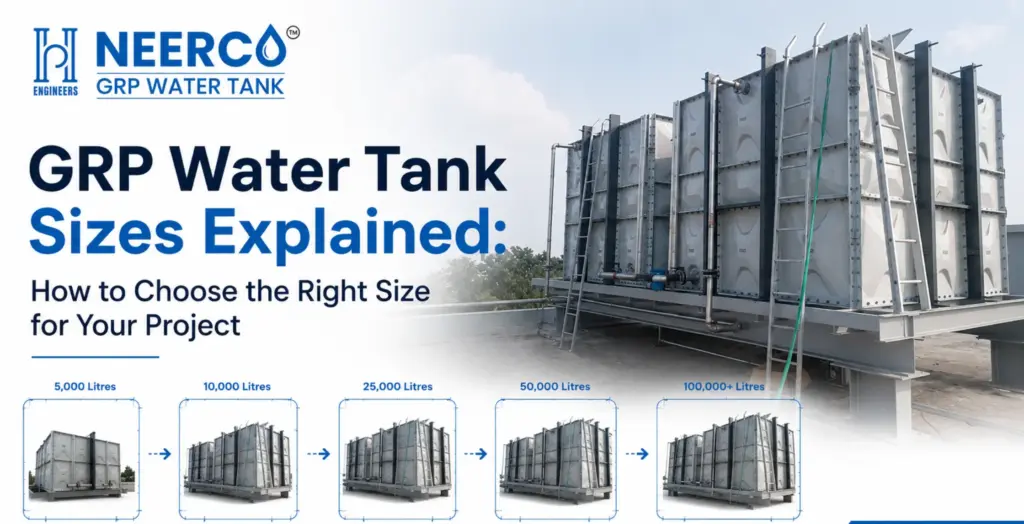
Choosing the wrong GRP water tank sizes is one of the most common and most avoidable mistakes in any water storage project. Too small, and you run out of water during peak usage or supply disruptions. Too large, and you are paying more than necessary for civil work, installation, and space that is not being used.
GRP water tanks are flexible by design. Because GRP panel tanks are modular, they can be configured in almost any capacity, from a 1,000-litre rooftop tank to a multi-lakh litre industrial reservoir. But flexible options also mean the selection process needs to be done carefully.
This guide explains GRP panel tank sizes, what factors determine the right capacity for your project, and how to make the final decision with confidence.
How GRP Panel Tank Sizes Work
As explained in the GRP Panel Tank Complete Guide, unlike a fixed-mould plastic tank that comes in standard sizes only, a GRP panel tank is built from individual modular panels, typically in 1m × 1m and 0.5m × 1m dimensions. These panels are bolted together on-site, which means the length, width, and height of the tank can each be adjusted independently.
This is what makes GRP water tank sizes and capacity so flexible. A 10,000-litre tank can be configured as a tall, narrow tank for a space-constrained rooftop or as a wide, low-profile tank for a basement installation; same capacity, different footprint.
The standard panel module is 1 metre, with 0.5 metre increments also available. This allows capacity to be fine-tuned to match the exact requirement of the project rather than forcing a round number compromise.
Common GRP Water Tank Sizes and Capacity Reference
The table below shows commonly used GRP panel tank sizes with approximate dimensions and typical applications. Actual dimensions can vary based on configuration.
| Capacity | Approx. Dimensions (L × W × H) | Typical Application |
| 1,000 L (1 KL) | 1m × 1m × 1m | Small residential, individual homes |
| 2,000 L (2 KL) | 2m × 1m × 1m | Small homes, shops |
| 5,000 L (5 KL) | 2m × 1m × 2.5m | Mid-size homes, small offices |
| 10,000 L (10 KL) | 2m × 2m × 2.5m | Residential buildings, hostels |
| 25,000 L (25 KL) | 5m × 2m × 2.5m | Commercial complexes, schools |
| 50,000 L (50 KL) | 5m × 4m × 2.5m | Hospitals, hotels, factories |
| 1,00,000 L (100 KL) | 5m × 4m × 5m | Large industrial, fire-fighting reserves |
| 5,00,000 L + | Custom configuration | Municipal, large-scale infrastructure |
These are reference configurations. GRP panel tank types and dimensions are fully customisable based on the site layout and capacity requirement.
How to Choose the Right GRP Water Tank Size
Selecting the right size is not guesswork. There are four main factors that determine what capacity your project actually needs.
1. Daily Water Consumption
The starting point for any water tank size selection is understanding how much water is consumed daily at the site.
Standard consumption benchmarks used in India:
- Residential (per person per day): 135 to 200 litres
- Office/Commercial (per person per day): 45 to 90 litres
- Hospital (per bed per day): 340 to 450 litres
- Hotel (per room per day): 180 to 350 litres
- Industrial/Factory: Varies significantly based on process requirements
Multiply the daily per-person or per-unit consumption by the number of users or units. This gives you the base daily demand.
2. Storage Duration: How Many Days of Backup Do You Need?
Once you know the daily demand, decide how many days of storage you need in reserve.
For most residential and commercial projects in India, the standard is 1 to 2 days of backup storage. This accounts for municipal water supply disruptions, tanker delivery gaps, or pump failures.
For hospitals, hotels, fire-fighting systems, and industrial plants, a minimum of 2 to 3 days of reserve is recommended, and sometimes mandated by building codes.
Simple formula:
Tank Capacity = Daily Demand (litres) × Number of Storage Days
For example: A housing society with 100 residents, 150 litres per person per day, needing 2 days of backup:
100 × 150 × 2 = 30,000 litres
A GRP panel tank of 30,000-litre capacity would be the minimum recommended size for this project.
3. Available Space and Installation Type
GRP water tank sizes also depend on the physical space available for installation.
A rooftop installation typically has load-bearing constraints, the tank dimensions must fit within the available terrace area and the slab must handle the filled weight. For rooftop tanks, compact configurations with a higher height-to-footprint ratio are often preferred.
For ground-level or underground installations, footprint is less restrictive, and wider, lower-profile configurations are generally easier to maintain.
Knowing whether the tank will be installed on a rooftop, at ground level, in a basement, or underground helps determine which GRP panel tank types and configurations are appropriate for your site.
4. Future Expansion
One of the practical advantages of GRP modular tanks is that they can be expanded by adding more panels if water demand increases in the future.
However, it is generally better to plan the right size from the start. Expansion requires additional civil preparation and downtime. If you expect the project to scale, more floors, more residents, additional production capacity, factor that in during initial sizing.
A commonly used approach is to add 15 to 20 percent buffer to the calculated capacity during the first installation.
Looking for the right GRP water tank size and capacity for your specific project?
Get in touch with HP Engineers for a site-specific recommendation.
Contact UsGRP Panel Tank Size Selection by Project Type
Residential Buildings
For a standard 10-floor residential building with 4 flats per floor (40 flats) and an average of 4 residents per flat:
- Total residents: 160
- Daily consumption: 150 litres per person
- Daily demand: 24,000 litres
- 2-day backup: 48,000 litres
Recommended tank size: 50,000 litres (50 KL)
Schools and Educational Institutions
For a school with 800 students and 50 staff:
- Daily consumption: 45 litres per person (as per NBC norms)
- Daily demand: 38,250 litres
- 1-day backup: 38,250 litres
Recommended tank size: 40,000 to 50,000 litres
Hospitals
For a 50-bed hospital:
- Consumption: 400 litres per bed per day
- Daily demand: 20,000 litres
- 3-day backup (standard for healthcare): 60,000 litres
Recommended tank size: 60,000 to 75,000 litres
Industrial and Factory Use
Industrial water demand varies significantly by process type. A general production facility with 200 workers and moderate process water needs may require anywhere from 50,000 to 2,00,000 litres depending on the manufacturing process involved. For industrial projects, a site-specific assessment is always recommended.
Common Mistakes to Avoid When Selecting GRP Water Tank Size
Underestimating peak demand: Daily average consumption and peak-hour demand are different. If all residents use water at the same time, mornings and evenings, the tank needs to handle that surge without running dry.
Ignoring fire-fighting reserve: For commercial buildings, high-rise residential buildings, and industrial facilities, fire-fighting water reserve is a separate requirement under NBC norms. This capacity must be added on top of the domestic water storage calculation, not included in it.
Choosing size based on price only: A smaller tank costs less upfront but results in more frequent tanker deliveries, pump cycles, and supply disruptions, which add to operational cost over time.
Not accounting for the installation location: A tank that fits perfectly on paper may not fit on the available rooftop or basement footprint. Always finalise dimensions against the actual site plan before ordering.
When to Get a Custom Size
Standard GRP panel tank sizes cover most residential, commercial, and industrial requirements. But for projects with unusual footprints, long narrow basements, irregular terrace shapes, heritage buildings with restricted access, custom panel configurations are available.
Because GRP tanks are modular by nature, customising the length-width-height ratio to match a non-standard space does not significantly increase lead time or cost compared to a concrete solution built to the same specification.
For projects with complex requirements, sharing the site drawing and capacity calculation with the manufacturer allows for a site-specific recommendation.
Conclusion
Getting the GRP water tank size right from the start saves time, money, and operational headaches over the life of the project. The calculation is straightforward, daily demand, backup days, site constraints, and future growth, but each factor needs to be applied correctly for the result to be accurate.
GRP panel tank sizes are flexible enough to meet almost any requirement, from a 1,000-litre home installation to a multi-lakh litre industrial system. The key is knowing what your project actually needs before selecting a configuration.
Frequently Asked Questions
1. What is the standard GRP water tank size for a residential building?
For most mid-rise residential buildings in India, a 10,000-litre to 50,000-litre GRP panel tank covers the requirement, depending on the number of flats and residents. The actual size should be calculated based on daily consumption and required backup days.
2. What is the smallest GRP panel tank size available?
GRP panel tanks are generally available from 1,000 litres (1 KL) onwards. For very small requirements, other tank types may be more practical. GRP panel tanks become the preferred option from around 5,000 litres and above.
3. Can a GRP water tank be expanded after installation?
Yes. Because GRP tanks are modular, panels can be added to increase capacity. However, expansion requires site preparation and some downtime, so it is better to plan the right size from the start.
4. How do I calculate the GRP water tank size for my project?
Multiply the daily water demand (number of users × per person consumption) by the number of backup days required. Add a 15 to 20 percent buffer. For commercial or industrial projects, include fire-fighting reserve separately as per NBC norms.
5. Are GRP panel tank sizes the same across all manufacturers?
The standard panel module (1m × 1m) is common across the industry, but configurations, quality, and available increments vary by manufacturer. Always confirm exact dimensions and capacity with the supplier before finalising the order.