
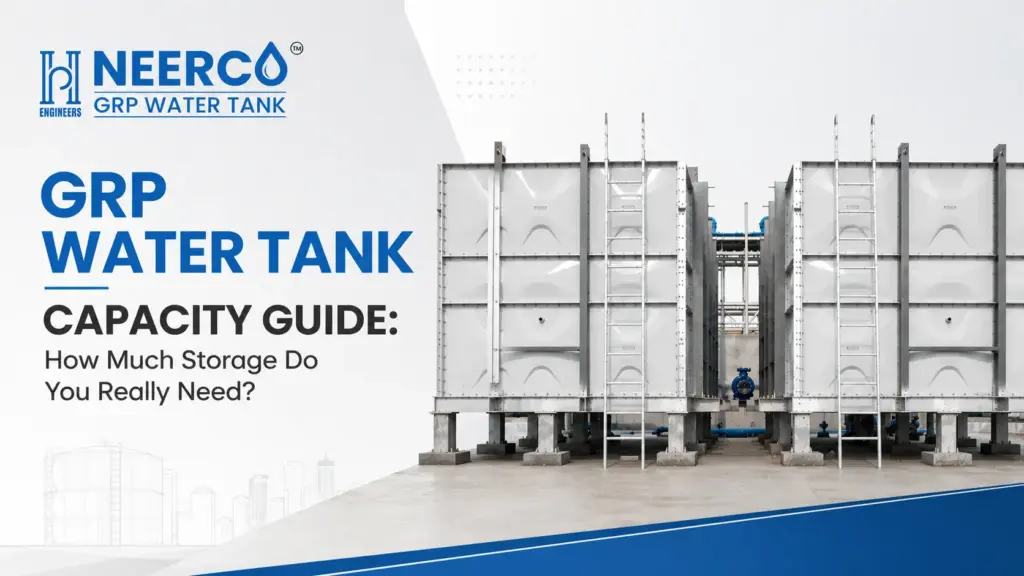
Most water storage problems do not start at the installation stage. They start at the planning stage, when the capacity is either underestimated or picked without a proper calculation. Too little capacity means the tank runs dry before the next supply cycle. Too much means you have spent on civil work, space, and installation for a tank that never fills completely. Neither is good.
GRP water tank capacity is one of the most searched questions by project owners, contractors, and facility managers in India, because the answer is different for every project. A home needs a different calculation than a hospital. A factory needs a different approach than a housing society.
This guide breaks down how GRP tank capacity works, how to calculate the right storage capacity for your specific project, and what GRP tank dimensions look like across common capacity ranges.
Why GRP Tank Capacity Is Not a Fixed Number
Unlike a packaged plastic tank that comes in fixed sizes, 500 litres, 1,000 litres, 2,000 litres, a modular GRP tank is built from panels. The capacity is determined by the combination of length, width, and height chosen during configuration.
As detailed in the GRP Panel Tank Complete Guide, GRP panels are manufactured in standard 1m × 1m modules with 0.5m increments also available. This means GRP water tank capacity can be configured in steps, from 1,000 litres all the way up to several lakh litres, without being restricted to pre-moulded sizes.
This flexibility is what makes GRP storage tank capacity so well suited to projects with specific space constraints or unusual footprints. The same 50,000-litre capacity can be achieved with a tank that is wide and shallow, or narrow and tall, depending on what the site requires.
GRP Tank Capacity and Dimensions: Reference Chart
The table below lists common GRP water tank sizes with capacities and approximate dimensions. These are standard reference configurations, actual GRP tank dimensions can be adjusted based on the site layout.
| Capacity | Dimensions (L × W × H) | Typical Use |
| 1,000 L (1 KL) | 1m × 1m × 1m | Individual homes, small shops |
| 2,000 L (2 KL) | 2m × 1m × 1m | Small residential, offices |
| 5,000 L (5 KL) | 2m × 1m × 2.5m | Mid-size homes, small buildings |
| 10,000 L (10 KL) | 2m × 2m × 2.5m | Residential buildings, hostels |
| 20,000 L (20 KL) | 4m × 2m × 2.5m | Apartments, small commercial |
| 25,000 L (25 KL) | 5m × 2m × 2.5m | Schools, clinics, mid-size offices |
| 50,000 L (50 KL) | 5m × 4m × 2.5m | Hospitals, hotels, factories |
| 1,00,000 L (100 KL) | 5m × 4m × 5m | Large industrial, fire reserves |
| 2,00,000 L (200 KL) | 10m × 4m × 5m | Municipal, large infrastructure |
| 5,00,000 L + | Custom configuration | Water treatment, large industrial |
GRP tank dimensions in the table above are approximate. For projects with specific site constraints, dimensions can be reconfigured to match the available footprint while maintaining the required capacity. Capacities listed are nominal; effective usable capacity is typically 85–90% depending on freeboard and inlet/outlet positioning.
GRP Tank Capacity Calculation: Step by Step
Calculating the right GRP water tank capacity for your project follows a straightforward method. Here is how it works.
Step 1: Calculate Daily Water Demand
The first number you need is how much water your site consumes every day.
Standard consumption figures used in India as per NBC (National Building Code) norms:
- Residential: 135 to 200 litres per person per day
- Office / Commercial: 45 to 90 litres per person per day
- Hospital: 340 to 450 litres per bed per day
- Hotel: 180 to 350 litres per room per day
- School / Institution: 45 to 70 litres per person per day
- Industrial / Factory: Depends on process, assess separately
Multiply the per-unit consumption by the total number of users or units to get your daily demand figure.
Step 2: Decide Backup Storage Days
Once you have the daily demand, decide how many days of backup storage you need.
For most residential and commercial projects in India, 1 to 2 days is the standard. This covers municipal supply interruptions, tanker gaps, or pump downtime.
For hospitals, hotels, and industrial facilities, 2 to 3 days is the recommended minimum. For fire-fighting reserve tanks, the requirement is set by NBC norms and local fire department guidelines, this is calculated separately and added on top of domestic storage.
Step 3: Apply the Formula
GRP Tank Capacity = Daily Demand (litres) × Backup Days
Add a 15 to 20 percent buffer on top of this figure to account for peak demand variation and future growth.
Step 4: Verify Against Available Space
Once you have the required capacity, check if the corresponding GRP tank dimensions fit the available installation space, rooftop, ground level, or underground. If the footprint is constrained, the height of the tank can be increased to maintain capacity within a smaller floor area.
Looking for the right GRP water tank capacity for your project?
Now that you know how capacity is calculated, let our engineers apply it to your project. Get in touch with HP Engineers for a personalised GRP tank recommendation tailored to your building type and daily water demand.
Contact UsCapacity Calculation Examples by Project Type
Residential Apartment Building
- 60 flats, average 3.5 residents per flat = 210 residents
- Daily consumption: 150 litres per person
- Daily demand: 31,500 litres
- 2-day backup: 63,000 litres
- 15% buffer: ~72,450 litres
Recommended GRP water tank capacity: 75,000 litres
School
- 1,200 students + 80 staff = 1,280 persons
- Daily consumption: 45 litres per person
- Daily demand: 57,600 litres
- 1-day backup: 57,600 litres
- 15% buffer: ~66,240 litres
Recommended GRP storage tank capacity: 70,000 litres
Hospital
- 80-bed hospital
- Daily consumption: 400 litres per bed
- Daily demand: 32,000 litres
- 3-day backup: 96,000 litres
- 15% buffer: ~1,10,400 litres
Recommended modular GRP tank capacity: 1,10,000 to 1,25,000 litres
Industrial Facility
- 300 workers + moderate process water requirement
- Worker demand: 300 × 70 litres = 21,000 litres per day
- Process water: assessed separately based on production type
- 2-day backup for worker demand: 42,000 litres
For industrial projects, process water and utility water are calculated independently and combined for the total GRP water tank capacity requirement. A site-specific assessment is always recommended before finalising tank sizing.
Underground vs Rooftop: Does Installation Type Affect Capacity?
The GRP water tank capacity itself does not change based on where the tank is installed. But the configuration, length, width, height, changes significantly.
Rooftop tanks
need to stay within the structural load capacity of the slab. This limits how large the footprint can be and how much water weight the structure can handle. Taller, narrower configurations are commonly used for rooftop installations to achieve the required capacity within a smaller footprint.
Ground-level and underground tanks
have fewer footprint restrictions. Wider, lower-profile configurations are easier to access for cleaning and maintenance. Underground GRP tanks also need to account for hydrostatic pressure from surrounding soil, this affects panel specification, not capacity.
Knowing the installation type before finalising GRP tank dimensions helps avoid a situation where the calculated capacity cannot be physically accommodated at the site.
Fire-Fighting Reserve: Separate From Domestic Storage
This is one of the most commonly overlooked points in GRP tank capacity planning.
For commercial buildings, high-rise residential buildings, hospitals, hotels, and industrial facilities, fire-fighting water reserve is a mandatory requirement under NBC norms. This reserve must be stored in a dedicated section or a separate tank, it cannot be combined with domestic water storage in the same tank without proper partition and isolation.
The required fire reserve capacity is determined by the building type, floor area, and occupancy, typically ranging from 50,000 litres to several lakh litres for larger projects.
Always calculate domestic water storage capacity and fire reserve capacity separately, then decide whether to install one combined partitioned tank or two independent GRP tanks based on the site layout.
Common Errors in GRP Tank Capacity Planning
Using average demand instead of peak demand
Morning and evening peak usage can be 2 to 3 times the daily average per hour. A tank sized only to daily average may still run dry during peak hours.
Not separating fire reserve from domestic storage
Combining both in one figure leads to either an undersized domestic supply or a fire reserve that is consumed during daily use.
Ignoring future demand
A housing society that adds floors, a factory that expands production capacity, or a hospital that adds beds, all of these increase water demand. Planning the GRP water tank capacity with a modest buffer from the start avoids costly rework later.
Finalising dimensions before checking the site
A tank configuration that fits the capacity calculation may not fit the available installation space. Always verify GRP tank dimensions against the actual site plan before ordering.
Conclusion
Getting GRP water tank capacity right is the foundation of a reliable water storage system. Undersize it and you face supply disruptions. Oversize it and you pay for space and civil work that adds no value.
The calculation, daily demand, backup days, buffer, fire reserve, is not complicated, but each step needs to be applied to your actual project numbers, not generic estimates.
GRP storage tank capacity is flexible enough to meet any requirement, from a 5,000-litre home installation to a multi-lakh litre industrial system. The key is knowing the right number before you finalise the configuration.
Frequently Asked Questions
1. How do I calculate the right GRP water tank capacity for my building?
Multiply your daily water demand (number of users × per-person consumption) by the number of backup days required. Add 15 to 20 percent buffer. For commercial projects, calculate fire reserve separately and add it on top.
2. What is the maximum capacity available in a GRP panel tank?
GRP panel tanks can be configured up to several lakh litres and beyond using modular panel combinations. There is no fixed upper limit, capacity is determined by the panel configuration and civil support structure.
3. Can I increase GRP water tank capacity after installation?
Yes. Because modular GRP tanks use bolted panels, additional panels can be added to increase capacity. However, this requires civil preparation and some downtime. It is better to plan for the right capacity from the beginning.
4. What are standard GRP tank dimensions for a 50,000-litre tank?
A common configuration for an approximately 48,000–50,000 litres GRP tank is 5m × 4m × 2.5m. Dimensions can be adjusted, for example, 4m × 4m × 3m, to match the available site footprint while maintaining the same capacity.
5. Is GRP tank capacity affected by temperature or outdoor installation?
No. GRP panels are UV-stabilised and rated for outdoor use. The capacity remains consistent regardless of whether the tank is installed on a rooftop, at ground level, or underground.