
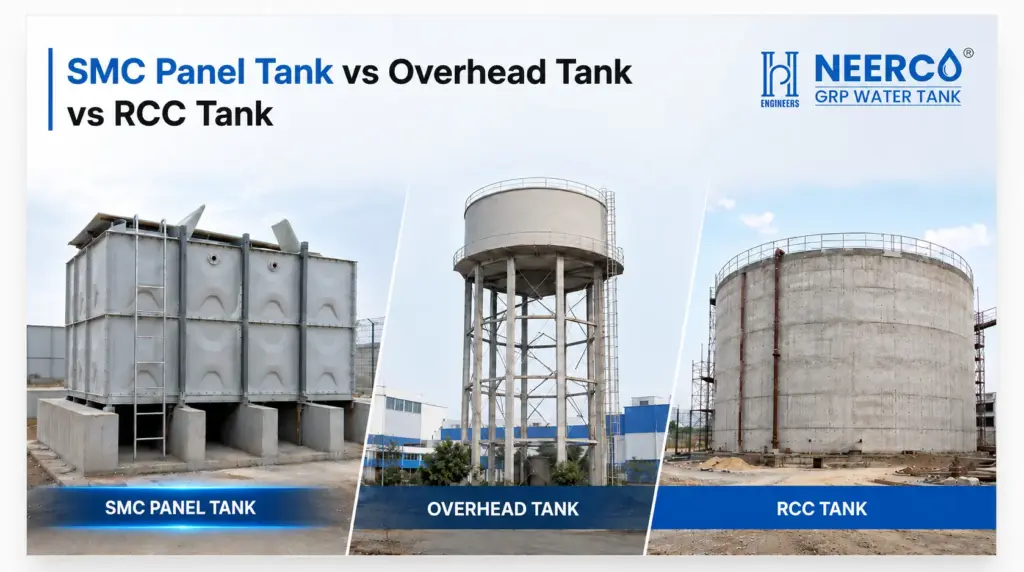
When planning water storage for a residential complex, commercial building, hospital, or industrial facility, most buyers face the same question: which tank should I choose? The three most common options in India are the SMC panel tank, the traditional plastic overhead tank, and the RCC (Reinforced Cement Concrete) tank.
Each option has its place – but they are not equal. With rising water storage requirements, stricter hygiene regulations, and increasing construction costs, choosing the wrong tank type leads to years of avoidable maintenance expense, water quality issues, and operational disruption.
This guide compares all three across every factor that matters: capacity, cost, installation time, water hygiene, durability, and long-term value – so you can make the right decision for your specific requirement.
What is an SMC Panel Tank?
An SMC (Sheet Moulding Compound) panel tank – also called a GRP panel tank – is a modular water storage system made from fiberglass-reinforced composite material. The tank is assembled from pre-manufactured panels that are bolted together on-site, giving complete flexibility in capacity and configuration.
SMC panel tanks comply with IS 14399 standards in India and are certified by ISI, CPWD (Central Public Works Department), and NSF International. Capacities range from 1,000 litres to over 10,00,000 litres, making them suitable for every scale of project.
HP Engineers manufactures SMC panel tanks under the NEERCO brand with tensile strength of 82.4 MPa – exceeding the IS 14399 requirement of 70 MPa by 17.7%.
Key Features of SMC Panel Tanks:
• Modular panel design – assembled on-site in any required configuration
• Non-corrosive, rust-free fiberglass composite material
• Smooth non-porous inner surface – prevents algae and bacterial growth
• Capacity: 1,000 litres to 10,00,000+ litres
• Certified: IS 14399, ISI, CPWD, NSF
• Lifespan: 20–30 years with minimal maintenance
• Installable underground, at ground level, on elevated structures, or on rooftops
What is a Plastic Overhead Tank?
A plastic overhead tank is a water storage container – typically made from HDPE or LLDPE – installed at an elevated position such as a rooftop to supply water by gravity. Brands like Sintex, Supreme, and Penguin dominate this segment in India.
Overhead tanks are easy to install and suitable for small residential needs. However, they are limited in capacity (typically up to 20,000 litres), prone to UV degradation over time, and not suitable for buildings requiring large-volume or hygienic water storage.
Common Types of Overhead Tanks in India:
• Plastic HDPE tanks (Sintex, Supreme) – residential, 1-5 floor buildings
• Steel overhead tanks – commercial, temporary water supply
• RCC overhead tanks – older buildings, rarely built new
What is an RCC Tank?
An RCC (Reinforced Cement Concrete) tank is a permanent water storage structure built on-site using concrete and steel reinforcement. RCC tanks are common in older government infrastructure, large residential complexes, and public water supply projects.
The core problem with RCC tanks is that they are built structures – not manufactured products. They cannot be relocated, expanded, or easily repaired. Cracks, seepage, and algae growth are common long-term issues.
Common Problems with RCC Tanks:
• Construction time: 4 to 8 weeks for a large tank
• Prone to cracks and seepage after 5–10 years
• Porous surface encourages algae and bacterial growth
• Expensive and disruptive to repair
• Cannot be relocated or expanded after construction
• High labour and civil work costs
SMC Panel Tank vs Overhead Tank vs RCC Tank – Full Comparison
The table below compares all three options across the parameters that matter most for building owners, contractors, and project managers:
| Parameter | SMC Panel Tank | Plastic Overhead Tank | RCC Tank |
| Material | Fiberglass composite (GRP/SMC) | HDPE / LLDPE plastic | Reinforced cement concrete |
| Capacity Range | 1,000L to 10,00,000L+ | 500L to 20,000L | Custom (usually large) |
| Installation Time | 1–3 days | Few hours | 4–8 weeks |
| Lifespan | 20–30 years | 5–10 years | 20–40 years |
| Maintenance | Very low | Low to medium | High |
| Water Hygiene | Excellent – non-porous | Good (UV degrades over time) | Poor – porous, cracks |
| Corrosion Resistance | Excellent | Good | Poor |
| Expandable / Modular | Yes | No | No |
| Certifications | IS 14399, ISI, CPWD, NSF | BIS | Structural design only |
| Relocatable | Yes | Yes | No |
| Long-term Value | Excellent | Poor | Moderate |
SMC Panel Tank vs Overhead Tank: 5 Key Differences
1. Capacity
A standard plastic overhead tank reaches a maximum of 20,000 litres. An SMC panel tank can be configured to store over 10,00,000 litres. For multi-storey buildings, hospitals, hotels, and industrial facilities, a plastic overhead tank simply cannot meet the water demand. SMC panel tanks scale to any requirement without structural limitations.
2. Lifespan
Plastic overhead tanks last 5 to 10 years before UV degradation causes discolouration, micro-cracks, and structural weakness. SMC panel tanks maintain their structural integrity for 20 to 30 years. Over a 30-year building lifecycle, you may replace a plastic overhead tank 3 to 4 times – each replacement adding cost and disruption – while your SMC panel tank continues to perform.
3. Water Hygiene
Plastic tanks exposed to sunlight develop micro-cracks over time that harbour bacteria and algae. SMC panel tanks have smooth, non-porous inner surfaces that resist contamination – a critical requirement for hospitals, food processing plants, pharmaceutical facilities, and drinking water applications. This is why CPWD and NSF certify SMC panel tanks for potable water use.
4. Expandability
If your water requirement grows – a new floor is added, the facility expands, occupancy increases – you cannot expand a plastic overhead tank. You replace it entirely. An SMC panel tank is modular: additional panels can be added to increase capacity without replacing the existing system. This modularity directly saves cost and avoids operational disruption.
5. Installation Flexibility
Plastic overhead tanks are limited to rooftop installation. SMC panel tanks can be installed underground as sumps, at ground level, on elevated staging, or on rooftops. This flexibility makes them suitable for every type of building and every type of water storage application – a single product that serves every need.
SMC Panel Tank vs RCC Tank: Why Industries Are Switching
Speed of Construction
An RCC tank for a large commercial project requires 4 to 8 weeks of civil construction work. An SMC panel tank of identical capacity can be assembled and commissioned in 2 to 3 days. For projects with tight schedules – airports, hospitals, industrial plants, infrastructure projects – this difference is decisive.
HP Engineers installed a large-capacity SMC panel tank at Mumbai Airport and completed a major water storage project at Reliance Industries, Jamnagar – both within compressed project timelines that RCC construction could not have met.
Maintenance and Repairability
When an RCC tank develops a crack – and all RCC tanks eventually do – repair requires shutting down water supply, draining the tank completely, and expensive civil work that may take days or weeks. With an SMC panel tank, a single damaged panel is replaced individually in hours, without shutting down the entire system or disrupting water supply to the building.
Long-Term Cost Comparison
The initial cost of an RCC tank may appear lower. But when you calculate the full lifecycle cost – construction labour, time, maintenance, crack repairs, eventual demolition, and replacement – SMC panel tanks consistently deliver better value. There are no recurring civil repair costs and no risk of contamination-related liability.
Which Water Tank is Best for Your Building?
For Residential Buildings (1–10 Floors)
A plastic overhead tank is adequate for small apartments with 1 to 3 floors and low occupancy. For buildings of 5 or more floors, or housing societies with 20 or more units, an SMC panel tank is the better long-term investment. The higher capacity, 20+ year lifespan, and superior water hygiene justify the cost difference from the first year of operation.
For Commercial Buildings, Hotels, and Hospitals
SMC panel tanks are the clear choice. Hospitals and hotels require large capacity, uninterrupted water supply, and strict hygiene compliance – standards that plastic overhead tanks and RCC tanks cannot reliably meet. CPWD and NSF certification makes SMC panel tanks the only option for government contracts and healthcare infrastructure.
For Industrial and Infrastructure Projects
Industries including manufacturing, food processing, pharmaceuticals, power plants, and airports should exclusively use SMC panel tanks. The speed of installation, modular scalability, hygiene compliance, and zero-downtime repairability are non-negotiable requirements at industrial scale. RCC tanks cannot meet these demands.
Frequently Asked Questions
Q1. What is the main difference between an SMC panel tank and an overhead tank?
An SMC panel tank is a modular fiberglass composite tank that can be configured from 1,000 to 10,00,000+ litres, installed in any location, and lasts 20–30 years. A plastic overhead tank is limited to 20,000 litres, installed only on rooftops, and lasts 5–10 years before UV degradation sets in. SMC panel tanks are IS 14399, ISI, CPWD, and NSF certified; plastic overhead tanks carry BIS certification only.
Q2. Is an SMC panel tank better than an RCC tank?
For most modern applications, yes. An SMC panel tank installs in 1-3 days versus 4–8 weeks for RCC construction. SMC tanks are modular and expandable; RCC tanks are permanent structures that cannot be relocated or modified. SMC tanks have smooth non-porous surfaces that maintain water hygiene; RCC tanks are porous and prone to cracks. The long-term maintenance cost of RCC tanks significantly exceeds that of SMC panel tanks.
Q3. How long does an SMC panel tank last?
A well-maintained SMC panel tank lasts 20 to 30 years. HP Engineers NEERCO tanks are manufactured to exceed IS 14399 specifications, with a tensile strength of 82.4 MPa against the required 70 MPa, ensuring long-term structural reliability. Individual panels can be replaced if damaged, extending the effective lifespan further.
Q4. Can an SMC panel tank be used as an overhead tank?
Yes. SMC panel tanks can be installed on rooftops over RCC or steel staging for overhead water supply applications – similar to how traditional overhead tanks are used. They offer the added advantage of higher capacity, better hygiene, and longer service life compared to plastic overhead tanks.
Q5. What is the cost difference between an SMC panel tank and an RCC tank?
The initial construction cost of an RCC tank may be slightly lower per litre for very large tanks. However, when you factor in the full lifecycle cost – construction time and labour, maintenance, crack repairs, eventual demolition, and replacement – SMC panel tanks deliver better value over a 20-30 year period. For detailed capacity-wise pricing, refer to our
Q6. Which water tank is best for a multi-storey residential building?
For buildings of 5 or more floors, an SMC panel tank is strongly recommended. It provides the capacity required for multi-storey water demand, meets hygiene standards for drinking water, and lasts 20+ years without major maintenance. A plastic overhead tank lacks the capacity and longevity for multi-storey applications, and an RCC tank takes too long to build and is difficult to maintain.