
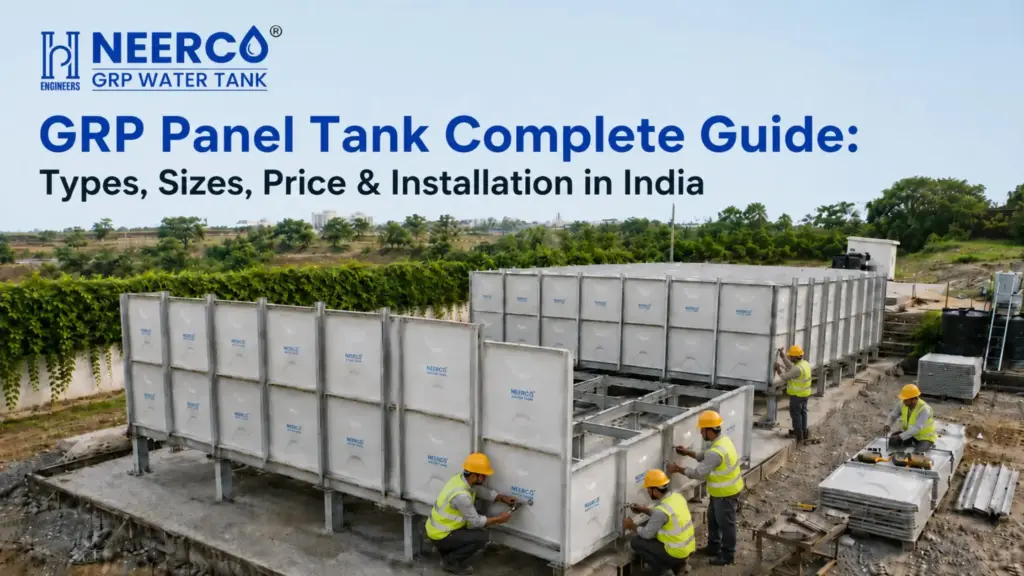
Choosing the right water storage solution is one of the most important infrastructure decisions for any home, building, factory, or public project. Among all the options available today, the GRP panel tank has become the preferred choice across India for its durability, hygiene, modular flexibility, and long service life. But before investing, most buyers want clear answers to the same questions: What types are available? What sizes and capacities can you get, what does it actually cost, and how is it installed?
This complete guide answers all of that in one place. Whether you are comparing GRP panel tank price in India, trying to understand GRP water tank sizes and capacity, or looking for a step-by-step installation breakdown, this resource gives you the practical, data-backed information you need to make a confident decision.
What is a GRP Panel Tank?
A GRP panel tank, short for Glass Reinforced Plastic panel tank, also called a GRP sectional panel tank, is a modular water storage tank built from individual pre-fabricated panels bolted together on-site. Each panel is made from glass fibre reinforced plastic, a composite material that combines the strength of glass fibre with the corrosion resistance of high-grade resin.
Unlike single-piece plastic tanks or heavy concrete tanks, a GRP sectional panel tank is assembled panel-by-panel, which means it can be built in virtually any capacity and shape to fit your exact site. This modular design is the core reason GRP tanks are used everywhere from small rooftop installations to massive industrial and fire-fighting reservoirs.
GRP Panel Tank Types in India
When exploring GRP panel tank types in India, the main classifications are based on installation location and application. Understanding these helps you select the right tank for your project.
1. Ground-Level GRP Panel Tanks Installed on a prepared flat foundation at ground level. These are the most common and easiest to install, ideal for industrial plants, commercial complexes, and large-capacity storage requirements.
2. Underground GRP Panel Tanks Designed for below-ground installation where space is limited or aesthetics matter. GRP water tank underground installation requires specialised structural reinforcement and proper foundation engineering to handle soil and water pressure.
3. Rooftop / Terrace GRP Panel Tanks Built for installation on building terraces and rooftops. GRP panel tank dimensions for rooftop applications are carefully calculated to match the building’s load-bearing capacity, and the modular panels allow easy transport up to the terrace.
4. Hot & Cold Water GRP Tanks Specially configured with insulated panels for temperature-sensitive storage in residential, hospital, and hospitality applications.
5. Fire-Fighting GRP Panel Tanks Manufactured to meet NBC (National Building Code) norms for fire safety. GRP fire fighting tank installation follows strict capacity, outlet, and structural requirements mandated for fire reserve storage in commercial and high-rise buildings.
GRP Water Tank Sizes and Capacity
One of the biggest advantages of GRP technology is flexibility in sizing. Because the tank is built from standard modular panels, typically 1 metre × 1 metre, 0.5 metre × 1 metre, and similar sizes, GRP water tank capacity can be configured in almost any combination.
GRP Panel Tank Sizes in Meters
GRP panel tanks are assembled using standard panel modules, allowing length, width, and height to be adjusted in 0.5m and 1m increments. This makes it possible to design a tank that fits an exact footprint, whether it’s a narrow basement, an irregular rooftop, or a large open industrial yard.
GRP Tank Capacity Chart
Below is a reference GRP tank capacity chart showing common sizes and their approximate dimensions. (A detailed GRP tank capacity chart PDF with full specifications is available on request.)
| Capacity | Approx. Dimensions (L × W × H) | Common Application |
| 1,000 L (1 KL) | 1m × 1m × 1m | Small residential |
| 5,000 L (5 KL) | 2m × 1m × 2.5m | Homes, small shops |
| 10,000 L (10 KL) | 2m × 2m × 2.5m | Residential societies |
| 20,000 L (20 KL) | 4m × 2m × 2.5m | Commercial buildings |
| 25,000 L (25 KL) | 5m × 2m × 2.5m | Hotels, hospitals |
| 50,000 L (50 KL) | 5m × 4m × 2.5m | Factories, schools |
| 1,00,000 L (100 KL) | 8m × 5m × 2.5m | Industrial/municipal |
For requirements that fall outside standard sizes, a custom size GRP water tank in India can be engineered to your exact capacity and space, there is virtually no upper limit when panels are combined.
GRP Panel Tank Price in India
Pricing is the question on every buyer’s mind, so let’s address it directly. The GRP panel tank price in India depends on several factors: total capacity, panel thickness, installation type (ground/underground/rooftop), foundation requirements, and location.
GRP Water Tank Price Per Litre in India
The most useful way to understand cost is the GRP water tank cost per litre. As a general benchmark, GRP panel tanks range from approximately ₹6 to ₹14 per litre of capacity, with the per-litre cost decreasing as tank size increases, larger tanks are more economical per litre due to shared structural and installation costs.
GRP Panel Tank Price List with Specifications
The following GRP tank price list with specifications gives indicative pricing for common capacities. Actual quotes vary by site and specification.
| Capacity | Indicative Price Range | Approx. Cost Per Litre |
| GRP panel tank 10,000 litre | ₹1.0 – ₹1.4 Lakh | ₹10 – ₹14 |
| GRP water tank 25,000 litre | ₹2.2 – ₹3.0 Lakh | ₹9 – ₹12 |
| GRP tank 50,000 litre | ₹4.0 – ₹5.5 Lakh | ₹8 – ₹11 |
| 100 KL GRP tank | ₹7.0 – ₹10.0 Lakh | ₹7 – ₹10 |
So when buyers search for specific figures like GRP panel tank 10000 litre price, GRP water tank 25000 litre price, GRP tank 50000 litre cost, 10 KL GRP panel tank price, 20 KL GRP water tank cost, or 100 KL GRP tank price India, these ranges provide a reliable starting point. For exact pricing, including GRP panel tank cost in Ahmedabad and across Gujarat, a site-specific quote is recommended.
Regional Pricing
GRP panel tank price in Gujarat and other manufacturing-hub states is often more competitive due to proximity to production facilities, lower logistics costs, and a strong base of established manufacturers. Buyers in and around Ahmedabad typically benefit from shorter delivery distances and faster installation timelines.
Additional Costs: Installation & Maintenance
GRP Tank Installation Cost
Beyond the tank itself, GRP tank installation is an additional cost that buyers should budget for. Installation charges depend on capacity, location accessibility (rooftop vs ground), foundation work required, and site complexity. As a rough guide, installation typically adds 8–15% on top of the tank price.
GRP Water Tank Maintenance Cost Per Year
One of GRP’s biggest long-term advantages is low upkeep. The GRP water tank maintenance cost per year is minimal; there is no rust treatment, no painting, and no structural repair cycle. Routine maintenance involves periodic inspection of joints and seals, and annual cleaning. This keeps lifecycle costs dramatically lower than steel or concrete alternatives.
GRP Panel Tank Installation Guide
Proper installation is critical to tank performance and longevity. Here is the GRP panel tank installation process step by step.
Step 1: Site Assessment & Foundation
The process begins with evaluating the installation site and preparing the foundation. GRP tank foundation requirements typically call for a level RCC (Reinforced Cement Concrete) platform or steel beam base, flat within ±3mm tolerance, capable of carrying the full water load. A correctly engineered foundation is the single most important factor in preventing future leakage and structural issues.
Step 2: Panel Delivery & Inspection
Pre-fabricated GRP panels are delivered to the site and inspected for quality, dimensions, and any transit damage before assembly begins.
Step 3: Base Panel Assembly
The base panels are laid first and aligned precisely on the foundation, with sealant applied between panels to ensure a watertight joint.
Step 4: Wall Panel Assembly
Wall panels are bolted vertically panel-by-panel, this is the core of how to assemble a GRP sectional tank. Each joint is sealed, and the bolts are torqued to specification. Internal and external bracing is added as required by the tank height and capacity.
Step 5: Roof Panels & Fittings
Roof panels are fixed, followed by the installation of inlet, outlet, overflow, drain, manhole, and ladder fittings as per the design.
Step 6: Hydrostatic Leak Test
The completed tank is filled with water and tested for leaks. Any seepage at joints is identified, and a GRP panel tank leakage repair solution, typically resealing the affected joint, is applied before final handover.
Installation on Terrace
For GRP panel tank installation on a terrace, the building’s structural load capacity must be verified first, and panels are transported in modular form for easy lifting. The lightweight nature of GRP panels makes rooftop installation far more practical than concrete alternatives.
Underground Installation
GRP water tank underground installation demands additional engineering, reinforced foundation, anti-buoyancy measures, and external structural support to resist soil pressure. This must always be handled by experienced installers.
Panel Thickness & Drinking Water Standards
For potable water, panel specification matters. The GRP panel tank thickness for drinking water is selected based on tank height and water pressure; taller tanks require thicker base and lower wall panels to handle the increased hydrostatic load. Food-grade resin and gel-coat finishes are essential to ensure the stored water remains safe and uncontaminated. Always confirm the tank meets relevant BIS and food-grade standards for drinking water applications.
How to Choose the Best GRP Water Tank Manufacturer in India
Finding the best GRP water tank manufacturer in India comes down to a few key checks:
- Certifications: Confirm ISI/BIS (IS 12701) and food-grade compliance
- Custom engineering: A good manufacturer designs to your exact site, not a fixed catalogue
- Installation support: Look for end-to-end service, design, fabrication, delivery, installation, and testing
- Track record: Proven projects across residential, commercial, industrial, and fire-fighting applications
- After-sales: Clear warranty, maintenance guidance, and leakage repair support
Conclusion
A GRP panel tank is one of the smartest long-term water storage investments available in India today, combining durability, hygiene, modular flexibility, and low maintenance across every application from rooftop homes to large industrial and fire reserves. Understanding the types, sizes, pricing, and installation requirements upfront ensures you choose the right tank and the right manufacturer for your project.
For accurate, project-specific pricing, including custom capacities, regional rates, and complete specifications, request a detailed quote from a certified GRP panel tank manufacturer who can assess your exact site and requirements.